The Apprenticeship Problem Inside AI-Assisted Software Teams
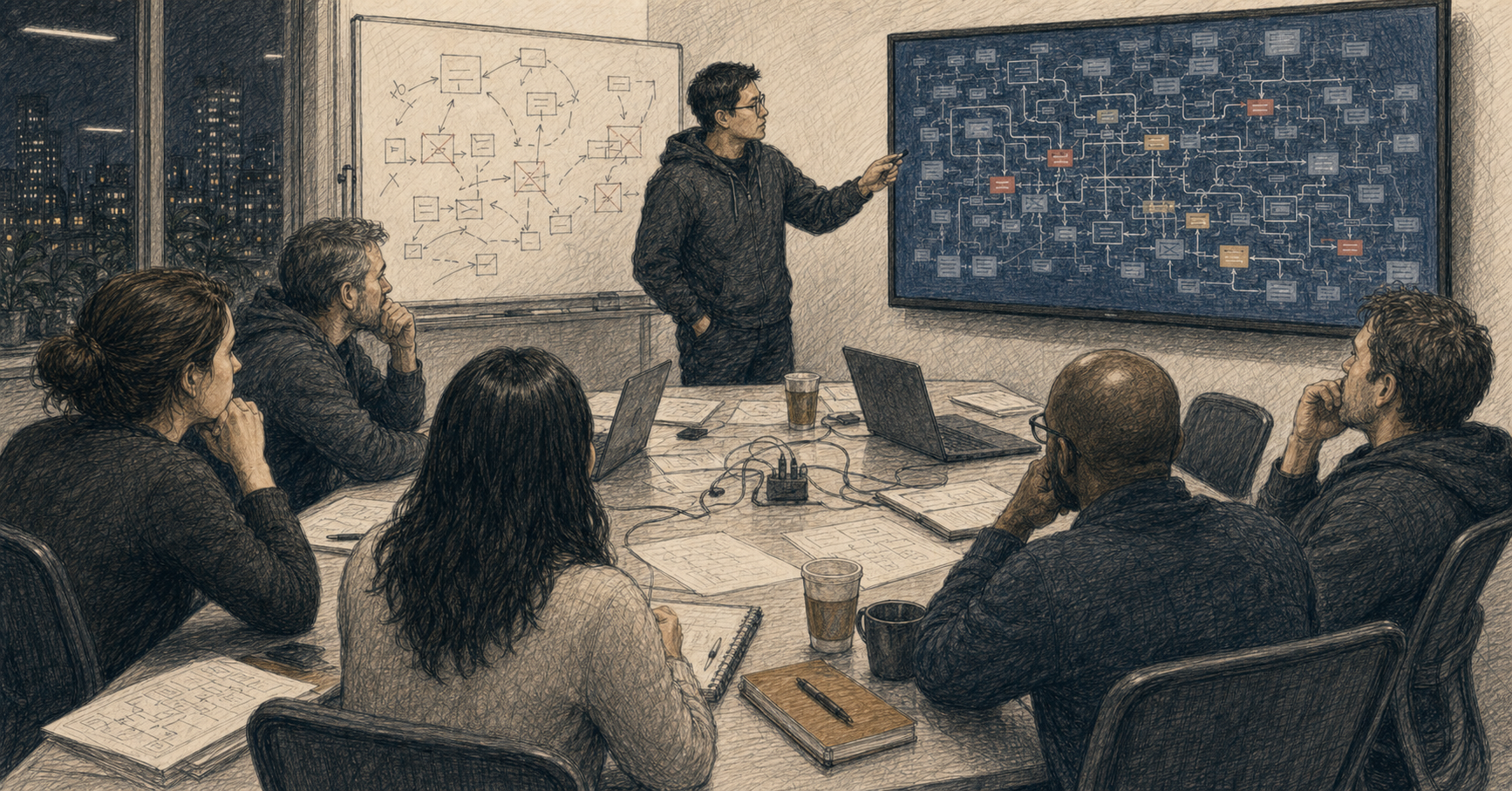
Picture a senior leadership meeting three years from now.
A customer-facing system has been failing for long enough that the incident is no longer only an engineering problem. Support is overwhelmed. Important customers want answers. The dashboards show where the symptoms are appearing, but the failure crosses services, generated code, and automated workflows that no one in the room fully understands.
The company has more software than it’s ever owned. It also has fewer experienced engineers who can hold the important parts of that software in their heads.
Someone proposes what the room can actually do: give better agents access to everything the company knows about the failing system. Let them find what the current agents missed.
The company’s trying to recover from a system it no longer understands by giving more authority to the tools that helped build it.
By then, turning to more AI may be the most practical choice left.
This meeting hasn’t happened. But the conditions that could produce it are beginning to.
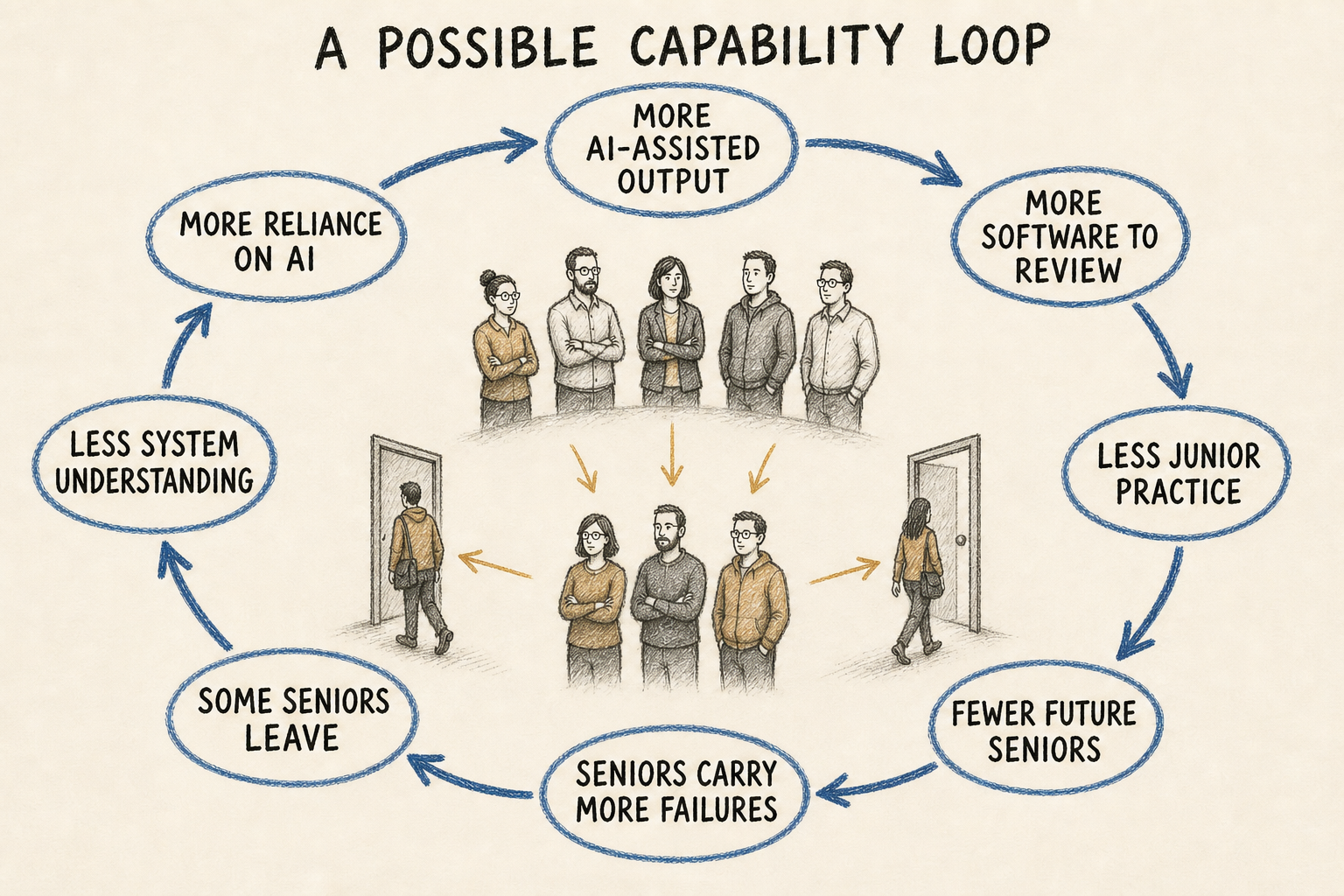
None of this starts with an obviously bad decision. It starts with software teams using AI to ship more work. In the process, junior engineers may get less of the hands-on practice that once helped them become capable senior engineers.
The bottom rung is already narrowing
Among workers aged twenty-two to twenty-four in the industry-state groups most exposed to AI, employment fell 12.4 percent relative to less-exposed industries between late 2022 and the middle of 2025—the preferred estimate in a 2026 US Census Bureau working paper.
The current software market is tilted even more clearly by seniority. In the first quarter of 2026, Indeed classified 4.5 percent of software-development postings as entry-level and 69.3 percent as senior-level.
AI is part of this story, though not the whole explanation. Remote work has made training inexperienced employees harder in some organizations. Interest rates and the post-pandemic correction also changed hiring.
What the evidence does show is a market where companies want experience while admitting fewer people into the jobs through which experience is acquired.
That can look rational one hiring decision at a time. A senior engineer can take responsibility sooner, and a senior engineer plus AI may complete work that once would’ve been delegated to a junior. A team under pressure can avoid the time it takes to teach someone who will move slowly at first.
That logic breaks when every company wants to buy experience and fewer companies are willing to help produce it.
The work AI removes was also the training
Some work deserves to disappear. Waiting on slow infrastructure, rewriting familiar boilerplate, searching for syntax, and repeating a transformation you already understand can consume time without adding much capability. AI can remove that work and give an engineer more opportunities to solve consequential problems. What else disappears with it?
Start with the capabilities we expect from a senior engineer. A senior can turn an unclear request into a tractable problem. Dropped into an unfamiliar codebase, they can build a model of how it behaves and identify where that model is wrong. They form debugging hypotheses, challenge a plausible-looking change, anticipate a failure, and recover a system when the first fix doesn’t work.
Then work backward: which experiences taught them to do those things?
A junior engineer faces a bug in an unfamiliar service. An agent may be able to inspect the repository, identify the likely fault, write a patch, add tests, and explain the result. The immediate task is completed.
But the task once contained a series of smaller decisions. Where should I start reading? Which log matters? What do I think the system is doing? What evidence would prove me wrong? Why did the first fix fail? What else could this change break?
The waste and the lesson were mixed together.
Dana Feng, Bhada Yun, and April Yi Wang studied how junior and senior engineers use AI at work. In one part of the study, ten junior engineers used AI to debug a React application they’d never seen. When they finished, five said their understanding of the codebase was only two out of five. None rated it five.
Elsewhere in the study, senior engineers gave AI more precise instructions and checked its work against knowledge they had developed before these tools existed. The researchers suggested that senior engineers review not only a junior engineer’s finished code, but also the prompts they gave the AI and how they evaluated its responses. That could reveal whether the junior understood the problem or merely arrived at working code.
My background with Precision Nutrition keeps pulling me toward an analogy. Eating is necessary. It’s usually good. But there’s a difference between eating while paying attention and consuming whatever arrives while your attention is somewhere else. What disappears is the awareness of what you consumed and how much of it accumulated.
AI is feeding engineering teams a richer and richer diet of completed work. The output can be impressive and worth accepting. The question is whether the team is consuming it consciously enough to notice what its people are no longer learning.
Conscious AI use asks teams to decide where the developing engineer still has to predict, inspect, explain, revise, and recover—and how they’d know whether those choices worked. The developmental function is what needs preserving, even when the old task used to provide it badly.
The gains hide the shortage
Preserving that function will be difficult, because the benefits arrive before the costs.
Hao He and his coauthors followed an AI-forward software company after its chief technology officer set a goal: double the number of proposed code changes each engineer got merged every month.
By April 2026, output per engineer had risen to 2.09 times its earlier level. As engineers produced more code, the amount each reviewer had to inspect roughly doubled. The company increasingly relied on automated review to handle the additional work.
Merge and rollback rates remained steady, but the study didn’t measure the longer-term risks at issue here: incidents, maintainability, ownership, understanding, or what engineers stopped learning.
That company shows what happens early. An output baseline can rise fast while pressure shifts into review and automation. Its data never describes the meeting I opened with.
These three trends won’t move at the same speed. Agent capability may jump. Hiring may recover, and training practices may improve only slowly. The risk comes from the mismatch: implementation capacity can rise faster than human capability is replenished.
Six months from now: the baseline moves.
A new agent capability becomes available. The fastest teams adopt it and demonstrate that more work can be completed with the same headcount. What looked exceptional becomes evidence for what everyone else should be able to do.
Less-experienced engineers still ship work. They may ship more than the cohort before them. But some implementation, investigation, and debugging now happens inside the agent before the engineer has built a model of the problem. Nothing obviously breaks. The dashboard records the additional output. The missing practice leaves no comparable trace.
One year from now: the missing practice compounds.
By this point, the higher baseline is part of planning. A manager deciding between a senior hire and a junior hire has another reason to prefer the person who can supervise AI immediately. Teams create more software, dependencies, and automations.
Some junior engineers have shipped more code than earlier cohorts but have less experience tracing a failure from its first symptom through recovery.
Senior engineers become the bottleneck. They review more AI-produced work and take over the incidents that less-experienced engineers can’t resolve. Release numbers can still look healthy while the ability to understand and repair the system becomes concentrated in fewer people.
Three years from now: the gap becomes impossible to ignore.
If junior intake remains thin and formative practice continues to shrink, fewer people reach the point where they can carry a difficult system through failure. Meanwhile, the organization owns three more years of software created under rising output expectations. You can’t decide at that point that you need more senior engineers and retroactively hire the juniors you chose not to train.
The shortage becomes visible only when the work stops being routine. A failure crosses service boundaries. An automated fix creates a new symptom. The people who remember why the systems were built that way are spread across too much work, or no longer there.
The obvious response is more AI: stronger agents given broader access and more autonomy. That may be correct for the immediate incident even as it deepens the organization’s dependence on the AI it used instead of replenishing human expertise.
A company can count every pull request it merges. It cannot count the senior engineer it failed to produce.
The industry’s wager
The strongest counterargument is that AI may become a better apprenticeship system than the one it replaces.
A junior engineer with an agent can ask questions they might be embarrassed to ask a colleague. They can receive immediate feedback, explore unfamiliar domains, and attempt work that would’ve previously been kept away from them. A well-designed workflow could create more complete practice cycles rather than fewer of them.
One experiment with ninety-seven graduate students tested a simple safeguard: require people to attempt the work before showing them AI’s response. Those students became better at spotting mistakes and irrelevant information, but the researchers found no measurable improvement in learning.
That’s the strongest version of the counterargument: AI might improve apprenticeship when it follows an independent attempt instead of replacing one. So far, the evidence shows a better process—not faster development of expertise.
This forecast could be wrong if organizations build that kind of apprenticeship into real engineering work. No study I’ve found follows AI-using junior engineers long enough to show that they become independently capable senior engineers faster.
That leaves the industry making a wager. The lost practice may not matter. But if companies still need the capabilities it produced, AI will have to create them another way before the shortage appears.
Back in the imagined meeting. When the agents fail in a way the agents didn’t predict, who in that room will know where to begin?
Notes and sources
- Lee C. Tucker, You're (not) Hired: Artificial Intelligence and Early Career Hiring in the Quarterly Workforce Indicators, US Census Bureau CES Working Paper 26-27, April 2026.
- Indeed Hiring Lab, The Labor Market Is Tilting Toward Seniority, July 23, 2026.
- Tucker, You're (not) Hired; Natalia Emanuel, Emma Harrington, and Amanda Pallais, Remote Work Leaves Younger Workers Sidelined, Federal Reserve Bank of New York, June 1, 2026.
- Dana Feng, Bhada Yun, and April Yi Wang, From Junior to Senior: Allocating Agency and Navigating Professional Growth in Agentic AI-Mediated Software Engineering, Proceedings of the 2026 CHI Conference on Human Factors in Computing Systems, 2026.
- Hao He and coauthors, AI Writes Faster Than Humans Can Review: A Longitudinal Study of an Enterprise “2×” Mandate, arXiv preprint, July 2026.
- Anjali Singh and coauthors, Hint-Writing with Deferred AI Assistance: Fostering Critical Engagement in Data Science Education, arXiv preprint, April 2026.