The Champions of Abundance
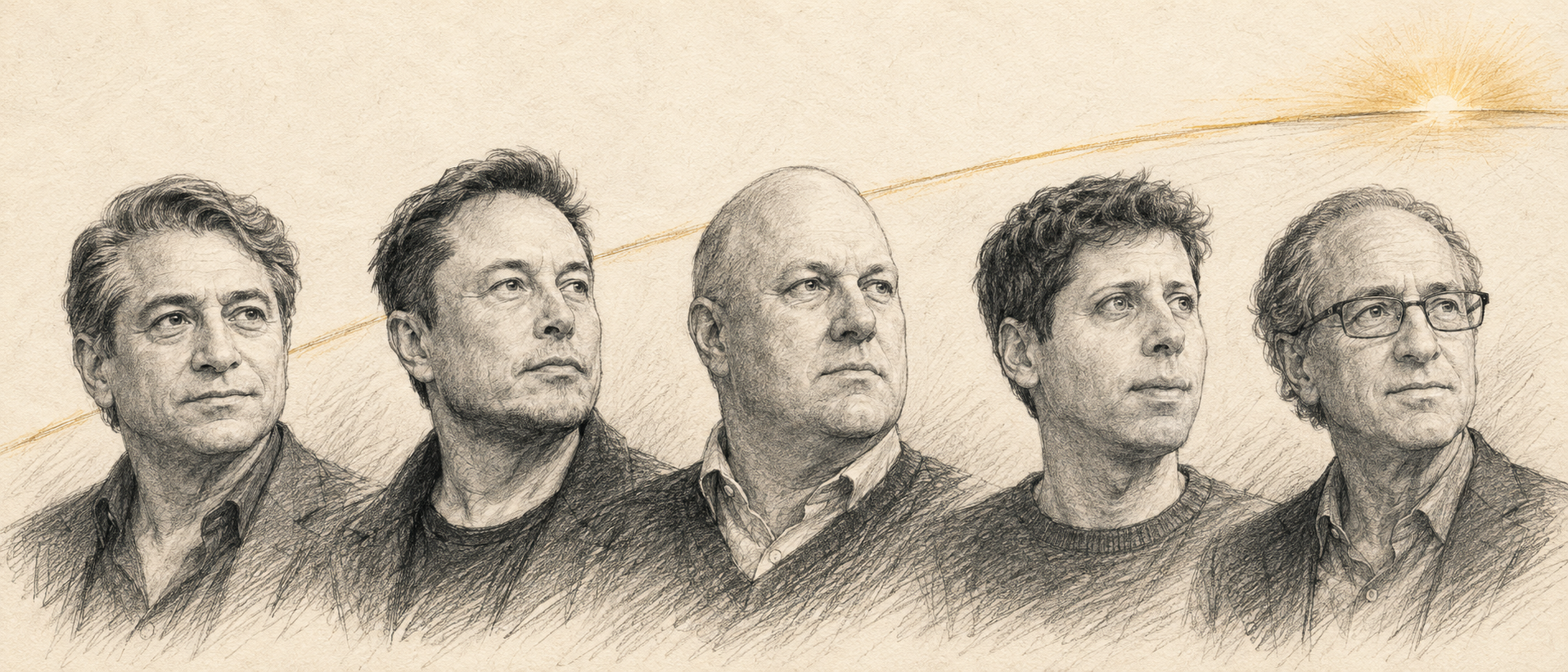
Spend a week inside the future and you start to hear the same promise in five accents.
Peter Diamandis says abundance for all is within our grasp. Marc Andreessen says we are "literally making sand think." Sam Altman says superintelligence might arrive in "a few thousand days." Ray Kurzweil has been circling the year 2045 for two decades. And Tesla, once a car company, has rewritten its mission around what it now calls "sustainable abundance."
Each of them is building toward a world with less friction, and each is unusually specific about how hard his own road was.
Diamandis gives the promise its cleanest name: technology as a "resource-liberating mechanism" that "can make the once scarce the now abundant." Andreessen makes falling prices the measure of abundance. Altman imagines intelligence so cheap that the price of "many kinds of labor" falls toward zero and everyone gets "a personal AI team."
It's a serious ambition, and a humane one. A lot of it is simply good.
In 1976, Kurzweil built a machine that read printed books aloud to blind people. To do it he first had to invent a flatbed scanner and a speech synthesizer that didn't exist yet. That's friction worth destroying—the kind that had locked an entire category of person out of the printed word for no reason anyone could defend.
Their projects also promise to remove barriers from work, education, and medicine. A robot that takes the overnight shift on the line, the one that wrecks a person's back and sleep for a wage. A kid stuck on a math problem at nine at night, with a patient voice on a laptop that will explain it a fourth time without sighing. Medicine that reaches further than the handful of specialists who used to hold it.
Some friction is just a wall. It keeps people from learning, healing, moving. The champions are right that removing these barriers is the point of progress.
The abundance keynote has a familiar set of slides. More energy, more intelligence, more medicine. A line that goes up and to the right, usually with enough confidence to make the axis labels feel unnecessary.
The slide that's never in the deck is formation.
The champions measure external results: price, access, speed. They do not measure whether the people receiving cheaper energy, intelligence, or medicine develop attention, judgment, or skill. Those abilities can develop through the friction the champions are removing, but none appears on the dashboard they use to keep score.
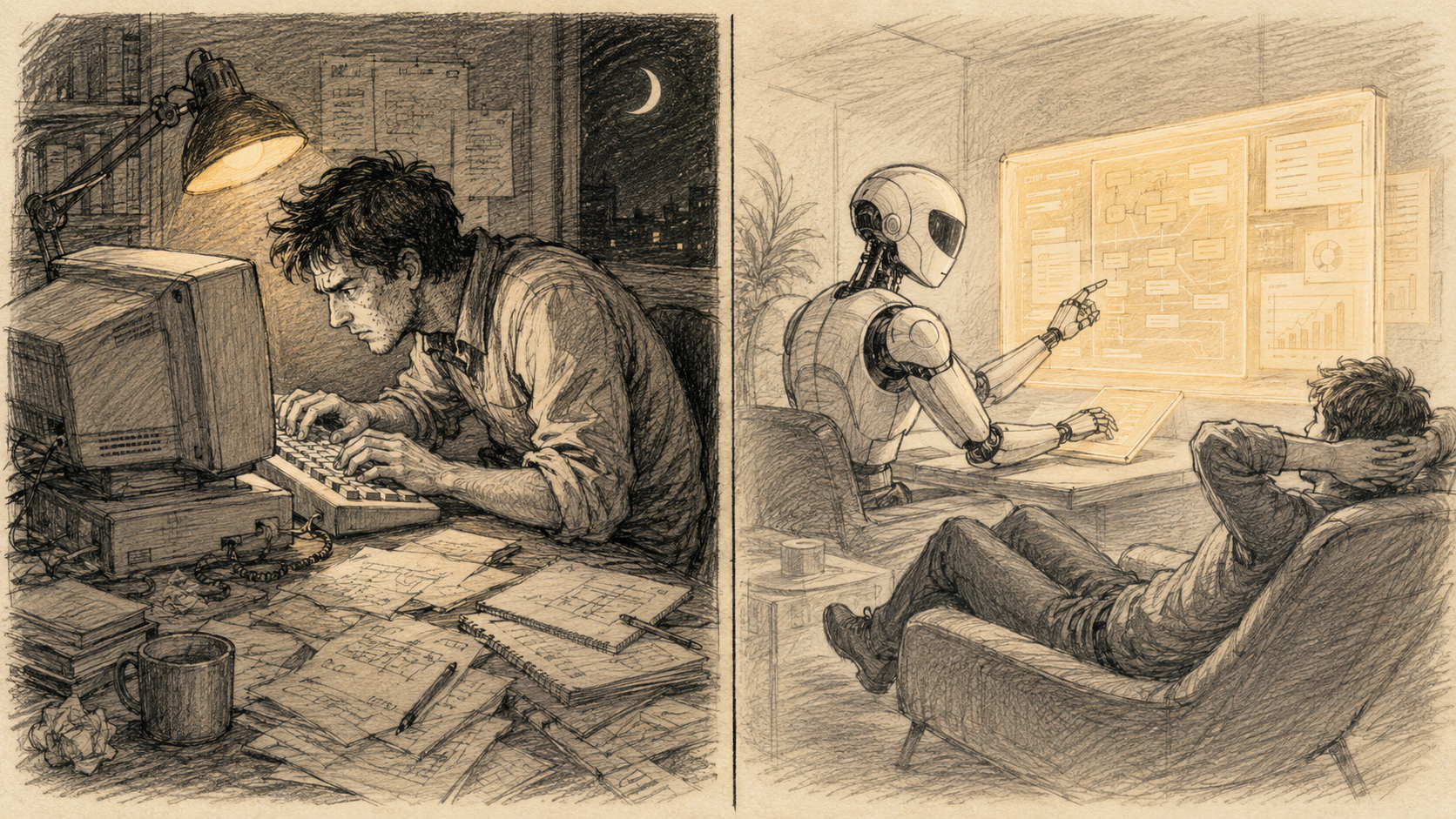
Andreessen's own story makes the contradiction plain. As a kid in rural Wisconsin he taught himself to code from a library book; as an undergraduate he helped build the first popular web browser in a university lab for a few dollars an hour. His manifesto tells the reader to go "hands on," gain "practical skills," and struggle. In a separate AI essay, he promises everyone else "an AI tutor that is infinitely patient, infinitely compassionate, infinitely knowledgeable." Struggle is how you become a technologist. Infinite patience is what you sell to the people who use what technologists build.
Altman dropped out of Stanford at nineteen and spent most of a decade on a startup that raised tens of millions and never quite worked, then ran the incubator that put a generation of founders through the wringer. His guide to success says "extreme people get extreme results." Then his essays promise a world where the personal AI team does the work and the price of labor falls toward zero.
During the Model 3 ramp, the stretch Musk named "production hell," he slept on the Tesla factory floor and worked up to 120-hour weeks.¹ Tesla now frames its humanoid robot, Optimus, as taking the "monotonous or dangerous" jobs so people get "more time to do what they love." Musk has said the quiet part out loud: in a world where work becomes optional, "it is less clear how we will find meaning." He names the hole and keeps digging.
Diamandis launched the XPRIZE before he had the full ten-million-dollar purse secured. For years he pitched more than 150 funders and kept hearing no. Now he talks about AI as a way to "deliver wisdom" at scale: instant access to patterns other people had to learn the hard way.
They don't hide their own formation or hoard struggle like a trade secret. They simply don't include formative struggle in their measures of abundance.
People fluent in the value of struggle are building systems that promise to make struggle optional.
AI is the broadest version of their promise. It makes the outputs of intelligence cheap: the answers, the essays, the code. But an abundance of outputs doesn't add up to competence.
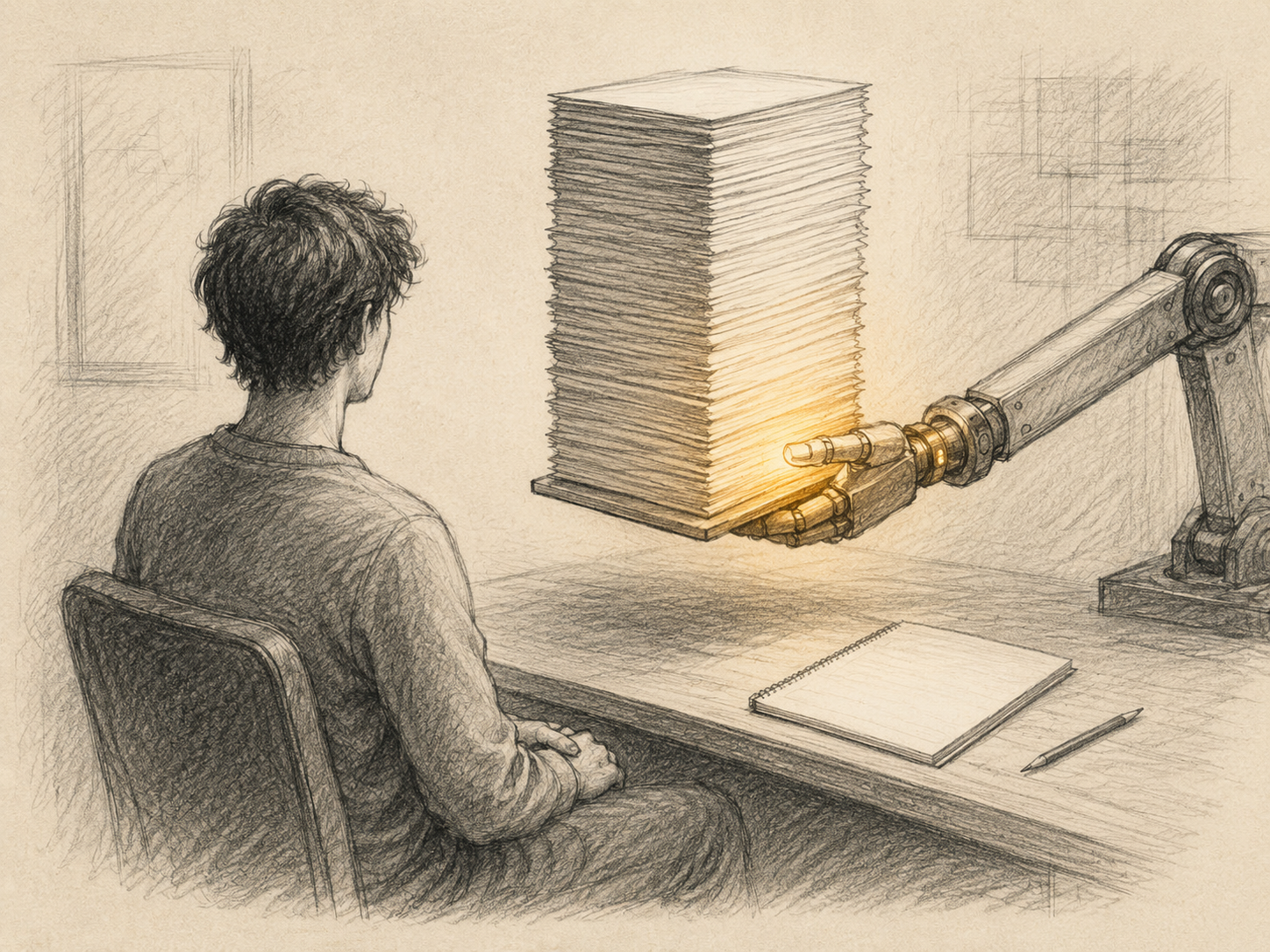
In a 2025 study of roughly a thousand high-school math students,² a basic AI helper raised their scores during practice, then left them worse than classmates who'd never touched it on the exam they had to sit alone. A version rebuilt to withhold answers and nudge students toward them preserved most of what they'd learned. Same model, opposite result. The difference was how much of the student's own effort the tool left in place.
The same pattern appeared among experienced doctors. Those who had spent a few months leaning on AI during exams became worse at spotting precancerous growths once they worked unaided; in a 2025 clinical study, their detection rate fell by roughly six percentage points.³
Andreessen's infinitely patient tutor and Altman's dashboard count intelligence delivered, not competence built. The same tool can help someone develop competence or do the work for them, and the champions' metrics do not distinguish between those outcomes.
The champions have the capital, scale, and conviction to build what comes next. That's why the missing slide matters. They're building the future with a dashboard that cannot measure the years of difficulty that shaped their own judgment, even as they build systems meant to make that difficulty optional for everyone else.
The open question is whether the people receiving all that abundance will end up as capable as the people building it.
Notes and sources
- Elon Musk, interview with The New York Times, August 2018, on the Model 3 production ramp; widely reported at the time, including CNN Business, "Elon Musk: This has been the most painful year of my career," August 17, 2018.
- Bastani et al., "Generative AI without guardrails can harm learning," PNAS 122(26), 2025. Single subject and setting; the guardrailed ("tutor") condition largely mitigated the effect.
- Budzyń et al., on AI exposure and endoscopists' unaided adenoma-detection performance, Lancet Gastroenterology & Hepatology, 2025. Observational; detection fell roughly six percentage points, about 28% to 22%.